 Using a professional camera can be daunting. This tip sheet will take you through the basics, get you more comfortable and have you looking like a pro! No matter what model of camera you’re using, the basic terminology, modes and controls will remain the same, and mastering the basics will greatly improve your finished photos.
Author: Joelle Harms
Golfdom State of the Industry Report
By Seth Jones and Grant Gannon
 To view a PDF of the 2015 Golfdom Report, click here.
From big expectations for the new year to disappointment with the current assistant superintendent pool, here’s how readers see the state of the industry.
This is the year, it seems. The year the economy starts to really bounce back, the year golf’s grow-the-game programs start taking hold.
But it’s probably not the year you find the assistant superintendent of your dreams.
In late December and early January we surveyed our readers, asking 16 multiple-choice questions and two open-ended questions. We learned a lot about the industry from the 591 responses we received. Here are the results of those questions, with a few stashed away for future use.
We learned that readers are confident that the national economy will grow in 2015 (see page 21), that they don’t believe oversized golf cups will help the game (see page 23) and that the ability to retire is the their biggest concern (29 percent), trumping stress (18 percent) and job security (15 percent).
We were also excited to see another uptick in our own numbers: 54 percent of respondents said Golfdom was their favorite turf magazine. That’s up from 45 percent two years ago, and 51 percent last year. Sure, it was our own survey, but we like the direction that number is going.
Read on to see how the most valued readership in golf sees 2015, from the economy to their most important tools.
2015: Let’s do this

Confidence in the economy jumps, remains steady in the facility
Jeff Leuzinger, sales manager for Illinois-based Healthy Grow, travels the country to visit with superintendents. A former superintendent himself, he might call Illinois home, but his office is the road.
And he likes what he’s seeing out there.
“I’m very optimistic for 2015. I see more activity and more rounds played and I see clubs more willing to spend money,” Leuzinger says. “Not new courses, but the courses that are operating are looking to invest in their courses.”
 One key indicator he sees is in fairways hit. No, not a driving statistic, but as an application area. The fairways are back in play, he says. The survey seems to echo that sentiment, with 29 percent of respondents saying their maintenance budget has increased for 2015.

“I see more superintendents interested in using our products on fairways,” he says. “That hasn’t been the case in the last couple years.”
It seemed that everyone we talked to — and 50 percent of our readers — are optimistic that the national economy will improve in 2015. That’s up from only 31 percent last year.
Tim Kreger, executive director of the Carolinas GCSA, was enjoying a five-course meal when we contacted him to ask the question.
“Five-course” as in five golf course maintenance crews celebrating the holidays together with a barbecue. Clearly, his mood was jovial, perhaps a combination of the biggest Carolinas Conference and Show ever, along with the fun atmosphere of getting so many maintenance workers together.

“Things are looking pretty positive — I feel like all the Tier 4 decisions have been made and are done with, I think rounds are headed upwards and there’s some reconstruction and a couple new course constructions in our area,” Kreger says. “And mostly I’m looking forward to a good spring in 2015.”
 Incoming GCSAA president John J. O’Keefe, CGCS, director of golf course management, Preakness Hills CC, Wayne, N.J., says he’s also optimistic, sensing more money available at clubs for more capital improvements.
“There are a lot of initiatives that the allied (golf) groups are working on, a lot of programs dedicated to the growth of golf that are gaining traction,” O’Keefe says. “As far as GCSAA, I don’t see an increase in membership, maybe a slight decline, but we’re almost flat. The important thing is we’ve leveled out.”
At GCSAA headquarters in Lawrence, Kan., GCSAA CEO Rhett Evans says he’d check the “somewhat optimistic” box in our survey.
“I do look at things glass-half-full,” Evans says, “but I think there are going to be some opportunities out there in 2015.”

One of those early opportunities for Evans and the GCSAA will be the 2015 Golf Industry Show, which hits San Antonio for the first time since 1978. (For more on his expectations on the 2015 GIS, see sidebar.)
 “We certainly are going to be met with our fair share of challenges… I don’t see the amount of rounds and traditional golf picking up, but I do think golf pros are having some clubs adopt the initiatives that are under way — whether that be changing the way their business model looks, junior golf leagues, catering to families, etc.,” he says.
David Withers, president of Jacobsen, was on his way to the Sports Turf Managers show in Denver when we reached him. He counts himself as “slightly optimistic.”
“If the U.S. economy continues on its path of recovery and we can get a nice early spring as we did in 2013, we could see more money being allocated for maintenance equipment,” he says. “The possibility of a resurgent Tiger Woods could also have a positive impact on the industry, with his success typically bringing more people into the game.”
Steve Mona, CEO of the World Golf Foundation, says he’s optimistic. In typical Steve Mona form, he gives three reasons why: a better spring, a better economy and a nicer news media.

“The chances are pretty much in our favor that we’ll have a better spring (golf weather) than we did in 2014,” Mona says. “In 2014 much of the country had a terrible spring, which really set us back from a participation standpoint.

“Another reason is we had a really tough media cycle in 2014, in the way the media portrayed the health of golf. That may not have any direct influence on the success of a facility, but I do believe perception influences behavior,” he says. “A negative media cycle didn’t do anyone any good, trust me on that.
“The third one — and this is hard to judge, I’ll admit… but we’ve been on a good run, from an overall economy standpoint. Look at the stock market. Look at the price of gas,” Mona says. “Generally speaking, the economy will be favorable toward golf. A lot of golf participation gets fueled by how people feel about their general economic condition.”
Healthy Grow’s Leuzinger, who recently attended the 2014 Golfdom Summit, says he feels strongly that 2015 will be a good year based on what his clients are telling him.
“I ask (superintendents) the same question you’re asking me: how does your 2015 look?” he says. “They say the same thing I’m saying… they think 2015 is going to be a good year.”
Big expectations for San Antonio GIS
Is everything bigger in Texas?
The GCSAA has something special, it hopes, with the Golf Industry Show returning to San Antonio. It’ll be the first time since 1978 that the show has been there, bringing an element of freshness. And the association is excited that the hotels are within walking distance of the convention center, which will make it easier for networking, GCSAA CEO Rhett Evans says.“Our biggest indicator of how the year is going to be is the Golf Industry Show, it sets the stage for 2015,” Evans says. “Right now in December (2014) I already have an indicator of what 2015 will look like.”Everything in Texas is bigger, and Evans is hoping that will include the GIS… but it will be close. That indicator shows currently a GIS that will rival the size of the 2014 show in Orlando.Still, the fact that the 2015 GIS is nearing the size of the 2014 Orlando show is a good sign.
“Orlando is always our high-water mark, and San Antonio is rivaling that,” Evans says. “We recently increased our square footage goal from where we started. We’re currently only slightly below Orlando. We’re extremely excited about that.”
Incoming GCSAA President John J. O’Keefe, CGCS, says he believes there’s a positive buzz about this show.
“Our numbers are tracking great. People are going to love this show,” he says. “Everything is centrally located, so no bus service will be needed… everyone will be together.”
Evans says that hotel bookings are ahead of where they have been in recent years. But the key indicator, of course, will be how many people actually make the trek to San Antonio.
“We’re close to having 12,000 people, like we’ve had in the past,” Evans says. “We’ve got a lot of good feedback that San Antonio is a city people want to be in — it’s easy to do business there, it’s easy to network and it’s fairly inexpensive.”
Any luck with big cups?
Readers remain skeptical about alternative-size cups

In the November 2014 issue of Golfdom we took a close look at how superintendents were handling oversized golf cups, from 6-inch to 15-inch holes, on their courses. When the question was posed to our readers, a whopping 70 percent said the larger cups would not help grow the game.
Jay Neunsinger, superintendent at Tilden Park Golf Course in Berkley, Calif., is a rare breed. He’s one of the 11 percent of our respondents who have used oversized cups on his course and has seen success with them.
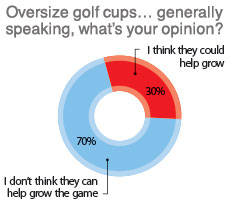 “I do think there have been some positive results with cups that have helped grow the game of golf,” says Neunsinger. “Some of the demographics that are a little bit younger and have higher handicaps enjoy using them because it’s more enjoyable for them.”
Neunsinger’s success has not come without its drawbacks. The majority of monthly pass holders are not using the oversized cups at all, and an unexpected challenge for golfers has arisen when greens have both sized holes open.

“The only problem I see with the big cups is (if) we put them in the back of the greens, (for) the people who are not playing those cups, if the big cup is in their putting line, they wonder what the rule is and if they can move their ball,” Neunsinger says.
Pete Tescher, superintendent at Golf Granby Ranch in Granby, Colo., agrees with the majority of readers that golf will not be grown through oversized cups but says they can serve a purpose.
“I think they’re fine for fun novelty occasions,” Tescher says. “People like the one (oversized cup), but not nine of them.”
Tescher cites the amount of labor it takes to cut and maintain two sets of cups as the reason why he, like 81 percent of readers, has never used the larger holes before.
 Tom Kaplun, superintendent at North Hempstead CC in Port Washington, N.Y., says the larger cups are not feasible because the tradition of the game is too strong. He has his own solution to grow the game. With his plan, changes happen off the course and not on the greens.

“Courses really need to look at ways to maximize their facilities. For example, looking to add practice facilities,” Kaplun says.
Kaplun thinks improved practice facilities will attract business to golf courses and more people to the sport because it allows beginners to build up their confidence. When people spend time at a course’s practice facility their comfort level grows, and they play more rounds.
Tescher shares a much simpler way for the sport to increase in popularity again: “Golf needs a new Tiger Woods,” he says.
Some things are easier said than done.
Help wanted
Survey shows an interesting trend: good help is getting harder to come by
 Tom Bolon, superintendent at Lake Forest CC in Hudson, Ohio, is in need of a new assistant superintendent and looks over the résumés he has received. Bolon advertised the position nationally and locally but only had a total of 25 applicants. He was not optimistic about the talent pool.
“It is hard to find someone really ready and willing to put in the time and effort,” Bolon says. “When I was an assistant superintendent my job was to take as much as possible off the superintendents’ plate, and people are not willing to do that.”
Sixty percent of readers agreed with Bolon that it has become harder in recent years to find and keep good assistant superintendents. The amount of applications being received and work ethic are not the only problem seen by readers.
David Groelle, GCCS, has not encountered any issue retaining assistants, calling himself “blessed” that he has only had to hire two in his 14 years at Royal Melbourne CC in Long Grove, Ill. Still, Groelle noticed a difference in the candidates’ education the last time he hired a new assistant.
“There aren’t as many applicants with full 4-year bachelor degrees. It seems to be becoming more of a trade, so to speak — where guys are learning on the job and getting experience in the field and maybe taking some classes on the side or going through programs online and getting an education that way,” Groelle says.
GCSAA’s O’Keefe usually retains three assistants at one time and he tries to provide a fair wage as they work their way through the ranks. But the current vice president of the GCSAA believes the cost of living is the reason it has been more difficult to find assistants in recent years.
O’Keefe, who will take over as president of the GCSAA at the 2015 GIS in San Antonio, says it takes the average assistant superintendent seven to eight years to attain their first superintendent job. In those years, it can be difficult for assistants to work a lot of hours and make a living on $50,000 a year while getting married and starting families.
“What I’ve found is that these guys are having to find a higher salary immediately, and they just can’t afford to work those eight years before getting that higher salary,” says O’Keefe. “And keep in mind, the eight years as an assistant is if you’re lucky.”
Those who make it through the years as an assistant are there because of the passion for the job, he says.
“Those who hang in there and get promoted, they love it,” says O’Keefe. “You only get into this industry if you love it.”
A superintendent’s best friend?

Sorry, course dogs. When it comes to getting the job done, you’re in the doghouse.
Superintendents utilize numerous resources every day to make their jobs run smooth and courses looking great. These implements vary from employees, technology, vendors and pets. Each has a function throughout the day, but we asked our readers to pick just one that is the most vital to completing the job.
When it came to their most important resource, 56 percent of readers stood up for a superintendent’s best friend: their assistants.
Vendors and their knowledge and help with products came in second place as the best resource, with 20 percent of the vote.
Smartphones allow superintendents to control their irrigation systems and track the path of the sun all from the palm of their hand. But it still came up in third place.
 Andy Engelbrecht, superintendent at Rotonda G&CC in Rotonda West, Fla., was among the 15 percent of readers who said his smartphone is the most important tool he has.
“I do so much on my smartphone, I almost don’t need an assistant,” Engelbrecht says (but don’t tell his assistant).
The companionship from a course dog, obviously a sentimental choice, only garnered 8 percent of the vote.
And what did we hear from our 3,000 followers on Twitter? That we left out the most important position of all: the course mechanic.
The best of the rest
From future story ideas to social media advice, our readers know best
We hope our subscribers enjoy reading the Golfdom Report as much as we enjoy compiling it… because every year, our readers come through with some insightful feedback.
For example, we learned that some of you would like to read more stories on sustainability. And a least one of you wants us to write a story declaring the death of the term; that in no way could golf ever truly be “sustainable.”
And we tip our cap to the reader who begs us to give up on the fad that is Social Media. After all, he writes — who the heck has time to write and read all that stuff? (We often find ourselves asking the same thing.)
To close out this installment of the Golfdom Report, we share a few more results from our survey. Half of you still don’t use Social Media for work. The GCSAA again gets an overwhelming thumb’s up. And happily, most of you, if given a choice, would do it all over again.
We’ll also do it all over again — in 2016. With your participation, it’ll be another fun, and insightful, project.


PMP State of the Industry Report
The industry’s vital signs are positive, and PMP’s expect a milder winter to boost 2015 revenue. Learn more about what respondents to the Pest Management Professional (PMP) 2015 State of the Industry survey had to say about their businesses. Plus, we put the spotlight on ants, bed bugs, cockroaches, rodents and termites.
View the 2015 State of the Industry Report here: (Download the PDF)

The evolution of the Android
By Dean Stanbridge
Throughout the years, I’ve spent a lot of time writing about the operating systems (OS) of the Blackberry and iPhone, but I’ve written little about the largest operating system for smartphones: Android. That’s because I was schooled on the other two operating systems and might be biased. Recently, though, I revisited Android technology to see how far it has come before I passed judgment.
Androids, also known as Droids, have skyrocketed in popularity over Blackberry and iPhone. If you choose to investigate one of these devices, don’t expect it to feel or operate anything like the other two platforms. Although the home screens look similar to the newest versions of the other two platforms, the functionality of an Android is quite different. There are less limitations because of proprietary issues with the other two platforms, and the ability to work with a much broader network of applications is possible. Google was smart enough to realize this OS was going to change the future of smartphones when it invested in it the late 1990s and bought the company in 2005.
Androids have had quite a rollercoaster ride since the first model hit the shelves in 2008. The initial concept of having an OS that was more open and app friendly than the front-running Apple iPhone operating system (iOS) was attractive to many people. The average Droid cost was less than the iPhone, and there were numerous free apps, which made the phones appealing to consumers who didn’t buy into Apple’s proprietary concept.
Unfortunately for Android manufacturers, this rollercoaster started on a high and quickly fell into its first low once users realized the open app market can be confusing. This sent consumers running back to stores to return devices. Unlike Apple, which test-markets and approves every app it releases, Android’s open app policy attracted almost every app developer in the world to test his app on the open market, with little real-world approval. This meant many apps were cumbersome and not user-friendly. Apple made sure it capitalized on this glitch and retrieved a vast number of users back to its iPhone.
But Google wasn’t about to lay down. It quickly recognized the platform was attractive to many tech types and the younger generation. Google made sure Androids worked seamlessly with all Google applications — even purchasing and partnering with some of the fastest-growing Internet communication services. Most of us have used their services, such as Gmail, and even visited Google Play, where you can find more than 1 million downloadable apps. Android maintains its presence as the largest OS in the world, and companies such as Samsung were forward thinking enough to make sure it climbed on board early. Samsung has become the largest installer of the Android OS and, in 2013, held more than 80 percent of the mobile phone market.
For those who might not be as tech-savvy as some of the younger generation who were attracted to the complexities of the Android OS, your fears should be calmed by newer versions. Manufacturers didn’t want to limit their market only to the young or technology-driven consumers. Today’s Android phones are much easier to use, and apps are rated on various sites to help users pick products that fit their technology comfort levels.
If you haven’t picked up an Android OS in a few years, talk to a product expert the next time you’re in a mobile provider’s store. You might be surprised how much these devices have matured.
NCM digital ad unit standards
NCM’s websites are flexible and nimble, offering advertisers numerous options. From the more traditional banner, leaderboard, skyscraper and box ad to the high-impact interstitial ad or wallpaper, there are several options available
to promote your company or product. Click here to download an Excel spreadsheet of our company-wide digital ad unit standards.
PQ 2014/2015 State of the Industry
By Darren Constantino

Large industry mergers lead the news as the aggregate industry’s outlook continues to climb.
The North American aggregates industry is in good shape based on recent aggregate production trends and predictions of near-term construction growth. And the nation’s two largest aggregate producers – Martin Marietta and Vulcan Materials – are also reporting positive news.
The past year kicked off with a successful ConExpo-Con/Agg trade show and Martin Marietta’s purchase of Texas Industries. The year also saw changes at the top of Vulcan Materials, where Tom Hill replaced Don James as president and CEO. James is now the company’s executive chairman.
Also, in 2014, the National Stone, Sand & Gravel Association operated for its first full year under the leadership of Mike Johnson. With Johnson, the association is revitalizing its efforts to secure a long-term highway bill, which saw another short-term extension this year: Congress passed an extension of Moving Ahead for Progress in the 21st Century, or MAP-21, through May 31, 2015, and authorized an additional $11 billion of transfers to maintain solvency of the Highway Trust Fund.
The U.S. Geological Survey says crushed stone production grew more than 9 percent in the third quarter of 2014, and construction sand and gravel was up nearly 8 percent.
What will we see in 2015? In addition to a return of the AGG1 Aggregates Academy & Expo – this time in Baltimore – the big news is the pending mega-merger of global heavyweights Lafarge and Holcim. The companies are discussing a union that would create one company whose combined annual sales are about $43 billion. The new company would be called LafargeHolcim, and the deal is expected to close in the first half of 2015.
“This proposed merger is a once-in-a-lifetime opportunity to deliver substantially better value to customers, with more innovation, a wider range of products and solutions, and more sustainability and enhanced returns to shareholders,” says Rolf Soiron, Holcim’s current chairman.
“LafargeHolcim will be uniquely positioned to take advantage of growth in developed markets and the world’s fastest growing economies by supplying the materials that will enable the construction industry to meet the challenges of the future.”
As a part of the merger-approval process, the companies are required to divest certain assets, and Reuters reports that Holcim is expected to have chosen buyers for those assets by the end of January 2015. Holcim says it expects to complete the deal by the middle of next year.
 Construction on the rise
In its 2015 Dodge Construction Outlook, Dodge Data & Analytics (formerly McGraw Hill Construction) predicts that total U.S. construction starts for 2015 will rise 9 percent to $612 billion, a larger gain than the 5 percent increase to $564 billion estimated for 2014.
“The construction expansion should become more broad-based in 2015, with support coming from more sectors than was often the case in recent years,” says Robert Murray, chief economist and vice president for Dodge Data & Analytics.
“The economic environment going forward carries several positives that will help to further lift total construction starts. Financing for construction projects is becoming more available, reflecting some easing of bank-lending standards, a greater focus on real estate development by the investment community and more construction bond measures getting passed.
“While federal funding for construction programs is still constrained,” Murray says, “states are now picking up some of the slack. Interest rates for the near term should stay low, and market fundamentals (occupancies and rents) for commercial building and multifamily housing continue to strengthen.”
Based on research of specific construction market sectors, the 2015 Dodge Construction Outlook details the forecast as follows.
- Single-family housing will rise 15 percent. It’s expected that access to home mortgage loans will be expanded, lifting housing demand. However, the millennial generation is only gradually making the shift toward homeownership, limiting the potential number of new homebuyers in the near term.
- Multifamily housing will increase 9 percent. Occupancies and rent growth continue to be supportive, although the rate of increase for construction is now decelerating as the multifamily market matures.
- Commercial building will increase 15 percent, slightly faster than the 14 percent gain estimated for 2014. Office construction has assumed a leading role in the commercial building upturn, aided by expanding private development, as well as healthy construction activity related to technology and finance firms. Hotel and warehouse construction should also strengthen, although the pickup for stores is more tenuous.
Transportation spending also on the rise
Energy prices remain relatively low, overall inflation is low, unemployment is holding around 6.2 percent, GDP is still a bit unsteady and growing slower than we’d like to see, but it “increased at an annual rate of 4.2 percent in the second quarter of 2014,” says FMI’s 2014 Q3 Construction Outlook Report. Select market predictions include:
- Transportation – Transportation construction continues at a solid pace with 7 percent growth in 2014.
- Residential – Multifamily construction is still expected to grow at a healthy pace of 13 percent in 2015 after reaching a near-record pace in 2014. The inventory for new homes increased to six months in July, showing some weakness in sales, but housing starts in July were 21.7 percent above July 2013 levels.
- Office – Dropping unemployment rates and rising GDP have provided a lift in the office forecast now expected to reach 8 percent growth in 2014 and grow an additional 7 percent in 2015. Large metropolitan areas like New York City will benefit the most, as vacancy rates drop to 10.6 percent compared with national vacancy rates hovering around the 16 to 17 percent range.
View from the top
Ward Nye, chairman, president and CEO of Martin Marietta, says his company’s third-quarter 2014 results reflect the acquisition of Texas Industries Inc., the benefits of our larger presence in the western United States, continued growth and enhanced profitability across the company’s heritage business and a disciplined approach to cost.
“The acquisition of TXI added $274 million of net sales and, even in advance of full integration and realization of significant synergies, contributed $44.5 million of gross profit, excluding the one-time increase in cost of sales for acquired inventory,” Nye says. “Based on our evaluation to date, we expect to surpass our stated target of $70 million in annual synergies prior to 2017. This transformational acquisition, when combined with our solid heritage business, creates a strong and broad foundation for dynamic revenue and profit growth in 2015 and beyond, positioning Martin Marietta to capitalize on increasing demand for building materials.
“In addition to aggregates and ready mixed operations, the TXI acquisition provided us with a leading position in the Texas cement markets, as well as a state-of-the-art, rail-located cement plant in Southern California. Driven by a sold-out Texas market, cement made a solid contribution to our quarterly earnings, as volumes increased 16 percent in the third quarter compared with the three months ended August 31, 2013, when Martin Marietta did not yet own the business.”
Nye says, “Job growth continues as a significant catalyst for construction activity, and Texas leads the nation in employment gains. Texas’ strong Department of Transportation budget is supporting investment in multiyear construction projects, including the expansion of Interstate Highway 35E in Dallas and the TIFIA-funded Grand Parkway project in Houston. These and other numerous state-level major projects have provided for continued stability in public-sector construction activity.”
Product line growth
For Martin Marietta, heritage aggregates product line shipments reflect growth in the three largest end-use markets. Shipments to the infrastructure market comprised 47 percent of quarterly volumes and increased 3 percent. Growth was strongest in the West Group, notably in Texas and Colorado, which continue to benefit from strong state Department of Transportation programs.
Highway awards in Texas increased about 26 percent for the trailing 12 months through August. Infrastructure shipments in Colorado were up 21 percent, reflecting activity from the Responsible Acceleration of Maintenance and Partnerships, or RAMP, program as well as reconstruction efforts resulting from the historic flooding in 2013.
The nonresidential market represented 30 percent of quarterly shipments and increased 3 percent, driven largely by energy-sector shipments. The company continues to benefit from the nation’s increasing investment in shale energy, particularly in South Texas. Martin Marietta believes this trend will continue, driven by $100 billion of anticipated energy projects along the Gulf Coast, including a significant portion in Texas, as well as anticipated infrastructure repairs in South Texas.
The residential end-use market accounted for 14 percent of quarterly shipments, and volumes to this market increased 9 percent. The overall rate of residential growth has slowed, owing in part to a reduction in available lot inventory. However, the company continues to experience significant growth in certain markets and expects an increase in aggregates-intensive subdivision development.
The company is encouraged by positive trends in its business and markets, notably:
- Nonresidential construction is expected to increase in both the heavy industrial and commercial sectors. The commercial building sector is expected to benefit from improved market fundamentals, such as higher occupancies and rents, strengthened property values and increased real estate lending.
- Residential construction should continue to grow, driven by historically low levels of construction activity over the previous several years, together with low mortgage rates, significant lot absorption, higher multi-family rental rates and rising housing prices. Total annual housing starts are anticipated to exceed 1 million units for the first time since 2007.
- Heritage aggregates product line shipments to increase by 6 to 8 percent compared with 2013 levels.
- Heritage aggregates product line pricing to increase by 3 to 5 percent for the year compared with 2013.
 Positive outlook
Tom Hill, president and CEO of Vulcan Materials Co., says, “Strong growth in aggregates volumes and solid operating performance in our aggregates businesses led to significant earnings growth for the company. Our third-quarter results continued to demonstrate the earnings leverage of volume growth in our aggregates business. We are also seeing the benefit of our continuing efforts to grow unit profitability and leverage our overhead structure.”
Over the past 12 months, aggregates shipments for Vulcan Materials increased 9 percent, or 13 million tons. During the same period, aggregates segment gross profit increased 30 percent, or $117 million.
“The overall pricing outlook for our aggregates products continues to improve with the recovery in demand for construction materials,” Hill says. “Our aggregates shipments have grown for six consecutive quarters, and we expect this demand momentum to lead to accelerating price growth. This lead-lag relationship between growing volumes followed by accelerating price growth is typical for our business. We already see price increases between 5 and 10 percent in certain markets, particularly where the recovery in construction activity is further along. As we look ahead, we believe price momentum will increase with continued volume growth.”
Aggregates sales were $689 million, up 15 percent from the prior year’s third quarter, due largely to strong volume growth across most of the company’s footprint. Third quarter aggregates shipments increased 12 percent compared to the prior year. Shipments in Illinois and Texas increased 31 and 21 percent, respectively, owing in part to large-project work.
Other markets, including Florida, Georgia, North Carolina and Virginia, reported volume growth of 10 to 15 percent versus the prior year. During the third quarter, the company completed several bolt-on acquisitions. Excluding shipments from these new operations, same-store aggregates shipments increased 10.5 percent from the prior year.
The freight-adjusted average sales price for aggregates increased 2 percent, or 23 cents per ton, versus the prior year’s third quarter, as almost all of the company’s markets realized price improvement. It marks the 13th consecutive quarter of year-over-year price improvement. The sharp volume increase in Illinois negatively impacted the overall increase in average selling price by 1 percent. Additionally, several large shipments of base material and other lower-priced products also impacted the reported average selling price for the quarter by about 1 percent.
2015 and beyond
Regarding the company’s outlook for the remainder of the year, Hill says, “Growth in private end markets continues to drive increased construction activity and demand for our products. Leading indicators, such as housing starts, nonresidential contract awards and employment levels, continue to show favorable above-average growth trends in Vulcan-served markets, and Vulcan markets continue to grow faster than U.S. markets as a whole.
Hill says the company will continue to convert these higher volumes into higher unit margins by operating efficiently at the plant level.
“This strong execution has resulted in a 19-percent increase in our trailing 12-month unit profitability, as measured by aggregates segment gross profit per ton, from what are already industry-leading profitability levels. This improved unit profitability, coupled with above-average demand growth, positions us well for significant future earnings growth.”
Based on these market trends, the company expects the following:
- Strong full-year aggregates volume growth near the top end of guidance range of between 7 and 9 percent, assuming normal weather patterns in the fourth quarter.
- Full-year pricing growth at the low end of guidance range of between 3 and 5 percent, with positive impact from current pricing actions benefiting price growth in 2015.
- Capital spending for 2014 to be about $240 million to support the increased level of shipments and to further improve production costs and operating efficiencies.
Hill says, “Our business continues to improve. Our employees remain focused on increasing unit profitability, delivering expected incremental earnings and improving our valuable aggregates franchise. Our confidence in the prospects for a sustained multi-year recovery in aggregates demand continues to grow. Our markets are recovering from trough levels of demand and are outpacing the rest of the U.S.”


North Coast Media, LLC • Privacy Policy • © 2026